 |
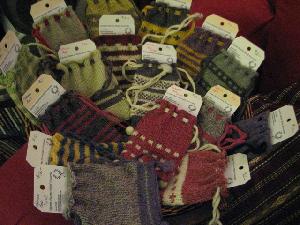
| knitted purses I make to sell |
|
The period is in the details - other accessories I've made that aren't embroideries or hand-sewn.
|
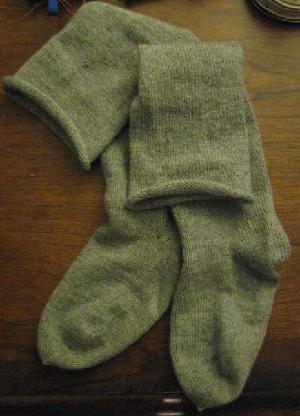
This is my first pair of knitted socks. I don't use patterns for knitting. Consequently, they're... interesting.
I'm honestly not much of a knitter - I pick up snippets of information from people as I go along, and apply my new knowledge to my next project, but I've never formally learned knitting, and I've never used a pattern. These socks were done by feel as much as anything, and they do show it a bit, but they fit perfectly, and they are nice and toasty at historical events.
They are made of 100% wool, of a colour that can be achieved without dyeing, like some of the surviving knitted pieces in the Museum of London. I did some terrible things, like make the toe pointy, rope the heel, and drop all sorts of stitches, but they fit, they're warm, and they're comfortable. As socks, they work very well.
|
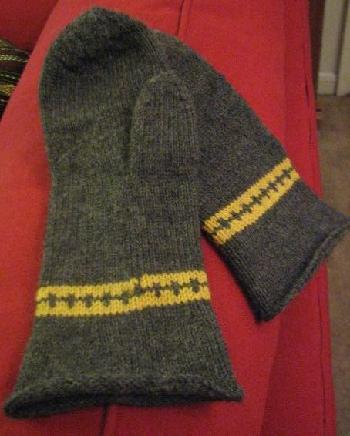
This is turning into the page of knitted things! This is a pair of mittens I made using a pair of knitted child's mittens in the Museum of London. The originals are light grey undyed wool with a darker undyed wool decorative band (with the lighter wool creating a pattern), but other than that, they're the same (as far as I can tell from a photograph in a book). I used 100% wool, which is massively less scratchy than people seem to think - these mittens are super soft, and work like a dream at cold events.
Like all my knitted objects, I don't use a pattern - I knit by eye and feel, and make notes as I go (which is, unsurprisingly, useful if I'm making two of something). The thumb was knitted with slightly smaller needles than the body, but it didn't seem to matter much. They're knitted in the round, like the originals appear to be.
|
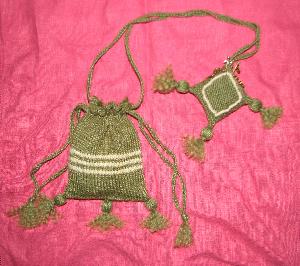
This is one of my knitted bags - the style is based on a knitted pouch found in Gunnister, Scotland that dates from the 17th century, crossed with the Elizabethan penchant for tassels on everything. The original pieces are in the National Museums Scotland.
While this is one of those "they might have done this sort of thing" items, and the primary knitted source is 100 years out of date, and it's the earliest surviving example of multi-coloured Shetland knitting (but by no means the earliest example of multi-coloured knitting), it's based on a bit of research into the kinds of things available in the 16th century, and the decorative styles that were most popular. Knitting was far more widespread and commonly employed than people used to think, and knitting in the round produces a perfect shape for a pouch. Small bags to hold essential items and small bags to hold gifts were common items, so...
It's a guess, but a fairly educated one. The knitted bag from the Gunnister find has a handsome three colour fair-isle/Shetland knit pattern (it's hard to tell exactly, since the bog it was found in stained everything brown - the repro in the link is very nice), so I'm fairly confident about the stripes. The number of lower economic level items we have is very limited, since such things rarely get saved. Most of the things we do have are from accidental burials, like the Gunnister Man, or tragedies, like the sinking of the Mary Rose. That such things are hard to find these days is not an indicator of their ubiquity in period - often, with cheap everyday things, they become very rare, as no-one bothers to save them.
Sometimes, you just have to guess. I don't like to do it too often, but sometimes I have no choice. And I likes my bags, yes, I does.
|
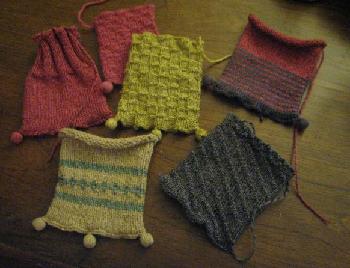
This is a sample of the kind of purses I've knitted in the last year. I occasionally sell at events, and Eadric the Potter sells things for me. One of the things I make a lot of is knitted purses - the knitting is fun and simple, and I like experimenting with different colours and techniques. I tend to spend far too much money on 100% wool hand dyed and hand spun wool, but it's an addiction, and I cannot stop.
Fortunately, people seem to like knitted things.
|
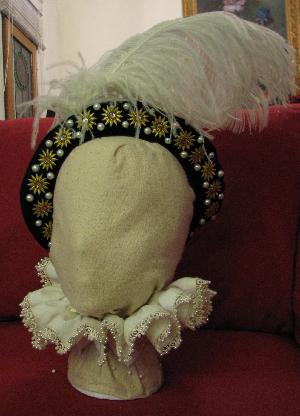
Adventures in artificial decoration - I made this hat to go with a green velveteen outfit, and only later decided that the flat cap and the outfit were not compatible time-wise; Elizabethan women don't seem to have worn flat caps as much as their German counterparts in the late 16th century.
I still like the way it looks, even though it uses modern materials for decoration and application - the pearls are glued on, and the stars are iron-on appliques (the same ones as the gloves below). While I always favour trying to re-create the real thing, there are times when using modern substitutes can be useful - such as making elaborate clothes for SCA royalty, who can't wait around a year and a half for an outfit to be done, but need to be appropriately dressed for their station.
|
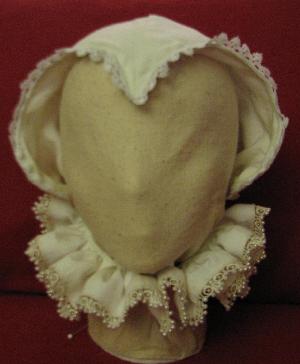
For everyone who's ever wondered what the heart-shaped coif is made of - it's a simple one-piece coif, wired at the front edge to create the effect. It works remarkably well, and looks particularly attractive when worn with Elizabethan hairstyles. It stays on well without slipping, and is extremely flattering to the face.
Please, don't call it an "attifet" - that's a term Herbert Norris came up with to describe the front wire of the coif (not the whole coif, just the front wire), and is not recognized as a correct name by museums (the Museum of London calls such wires "headdress frames"). He took it from the old French term for a lady's head decoration, and didn't use it correctly, much like he incorrectly called the English coat or gown a "Spanish surcoat" ("Ropa" is correct for Spanish clothing, "Gown" for English).
|
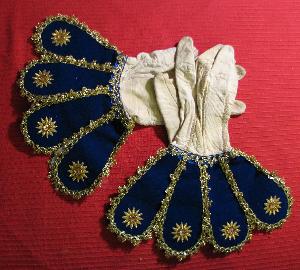
This is a test pair of gloves I made when I was exploring cuffs and methods of decorating them without many hours of embroidery (I ended up making a green pair for my apprentice when she was Queen of Atlantia). I don't wear these for a couple of reasons: The cuffs need to be lined, and the gloves I put them on are ratty old things in serious need of cleaning.
The materials are completely modern - I was researching methods of quick construction for period effect - and are no-nap velveteen (it doesn't fray), heavy fusible interfacing, modern gold-tone trim, and iron-on patches. The overall effect was pretty cool.
|
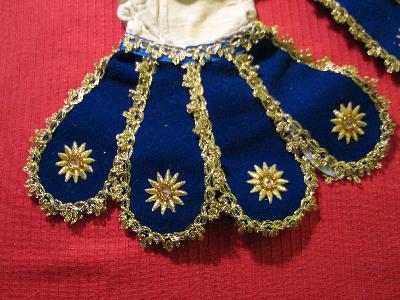
A close-up of the decoration. While I prefer to use period materials and techniques, I feel it is useful to work in modern materials so as to be able to give advice on the best choices to people who do not have the budget for silks and gold but need to achieve a certain level of impressiveness, like royalty.
|
|